


Accommodative Spasm: What It Is, Why It Happens, and How We Treat It
If your child complains of blurry vision, headaches, or eye strain that doesn’t clear up even with a new glasses prescription, the cause may not be a simple focusing error — it could be accommodative spasm, a treatable condition in the eye’s focusing system.
At Navigation Eye Care, we see this condition often in students whose visual demands — reading, screens, close schoolwork — have outpaced their eyes’ ability to keep up. Below, we explain what accommodative spasm is, the symptoms to watch for, and the treatment options we use to help patients recover clear, comfortable vision.
What Is an Accommodative Spasm?
Accommodative spasm is a term used in eye care to describe a breakdown in accommodation — the eye’s ability to focus at different distances, similar to a camera lens zooming in and out. The muscles responsible for this focusing adjustment stop working with the efficiency and precision they need to.
In a healthy visual system, the brain and eyes communicate constantly: when a task demands more focus up close, the eyes increase accommodation; when the eyes shift to something farther away, that focusing effort should relax. In accommodative spasm, this feedback loop breaks down. The signal between what the eyes need to do and what the brain tells them to do gets miscommunicated.
The result is a visual system that stays “locked” in a focusing state that doesn’t match the task at hand. This can cause:
- Constant blurred vision
- Eye pain and headaches
- General visual discomfort
- Difficulty learning or concentrating in the classroom
Symptoms of Accommodative Spasm and Accommodative Dysfunction
Beyond blur and headaches, one of the clearest signs of accommodative dysfunction is a drop in visual acuity that doesn’t respond normally to a change in prescription. In our experience treating this condition, we typically see:
- Distance vision around 20/50 or worse
- Near vision around 20/50 to 20/100
What makes this condition distinct is that increasing or decreasing the glasses prescription doesn’t reliably improve that acuity — a signal that the problem isn’t the prescription itself, but how the eyes and brain are working (or failing to work) together.
Treatment Options for Accommodative Dysfunction
The good news: accommodative spasm is treatable. It isn’t, however, an overnight fix. Because the condition reflects a pattern that’s locked in between the brain and the visual system, resolving it takes a coordinated, gradual approach rather than a single prescription change.
Specialty Glasses (Eyezen Lenses)
Treatment often starts with specialty lenses — such as Eyezen lenses — which provide a boost in support for near and detailed close up work, easing the strain on the focusing system.
Vision Therapy
Alongside specialty lenses, we typically recommend vision therapy: guided sessions designed to retrain the binocular system so the eyes and brain coordinate more effectively. Vision therapy timelines vary depending on how entrenched the spasm is, and in our experience typically range from six months to a year.
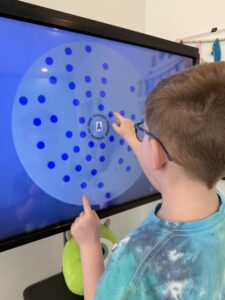
Learn more about our vision therapy program at Navigation Eye Care.
Specialty Contact Lenses (Defocus Technology)
An emerging alternative to glasses and vision therapy is specialty contact lenses that use defocus technology, helping the visual system relearn how to shift focus across different depths. This is more of an in office, hands on treatment approach. At Navigation Eye Care, we’ve seen strong results using these specialty lenses with several student patients, improving both their symptoms and their day to day visual function.
For clinical background, see the American Optometric Association’s consensus guideline on the care of patients with accommodative and vergence dysfunction.
The Bottom Line
Accommodative spasm doesn’t resolve the way a typical vision problem does — there’s no pair of glasses that delivers instant, perfect vision. But with the right combination of specialty lenses, vision therapy, or specialty contact lenses, there is real hope for meaningful improvement in symptoms, comfort, and quality of life. It’s an investment of time, aimed at getting to your best possible vision.
Schedule a comprehensive eye exam today at Navigation Eye Care in Chesapeake, VA because your child deserves clear, comfortable vision.
FAQ
What is an accommodative spasm?
It’s a condition where the eye’s focusing muscles lose the ability to adjust accurately between near and distance vision, often due to a miscommunication between the eyes and the brain’s focusing signals.
What are the symptoms of accommodative spasm?
Common symptoms include blurred vision, headaches, eye pain, visual discomfort, and reduced visual acuity — often distance vision near 20/50 or worse and near vision between 20/50 and 20/100 — that doesn’t fully correct with a prescription change.
How is accommodative spasm treated?
Treatment typically combines specialty glasses (such as Eyezen lenses), vision therapy, and in some cases specialty contact lenses with defocus technology. Timelines vary, with vision therapy often taking six months to a year.
Will new glasses fix accommodative spasm right away?
No. Because the condition involves the brain and eye focusing feedback loop rather than just the prescription, improvement takes time and a combination of treatments rather than a single new pair of glasses.
Who is most affected by accommodative spasm?
We commonly see this in students, whose heavy near vision demands from reading and schoolwork can be a factor in developing accommodative dysfunction.