

If you haven’t had an eye exam in a while, or you’re bringing your child for the first time, it helps to know what to expect. Here’s what happens during an eye exam at Navigation Eye Care in Chesapeake, step by step. Most of it is quick, and none of it hurts.
Before the eye exam
A little preparation makes the visit go smoother. Bring:
- The glasses or contact lenses you wear now
- Your insurance cards
- A list of medications you take
- Notes on any symptoms, like headaches, blurry vision or eye strain
It also helps to know if anyone in your family has eye conditions like glaucoma or macular degeneration.
What happens during an eye exam, step by step
Health history
Your visit starts with a conversation. Dr. Teten asks about your eyes, your general health and anything that’s been bothering you. For kids, she asks parents about reading, school and sports, because that’s often where vision problems show up first.
Pretesting
A team member may run a few quick tests before the doctor comes in. These can include an automated reading of your prescription and a check of the pressure inside your eyes.
The eye chart
This is the part everyone knows. You read letters at distance and up close so the doctor can measure how clearly each eye sees. Young children who don’t know letters yet use pictures instead.
Finding your prescription
If you need glasses or contacts, Dr. Teten finds the lenses that give you the clearest, most comfortable vision. This is where you hear “Which is clearer, one or two?” There are no wrong answers. If two choices look the same, say so.
How the eyes work together
Dr. Teten checks how the eyes work together: whether they point at the same spot, move smoothly across a line of text, and shift focus between near and far. Problems here can cause headaches, words that seem to move, and trouble judging distance, even when someone sees 20/20.
Aiden, one of our vision therapy patients, is a good example. He’s a baseball player whose depth perception problems were affecting his game. His eyes saw clearly, but they weren’t working well as a team. After consistent vision therapy, his ability to track and hit the ball improved dramatically.
Eye health
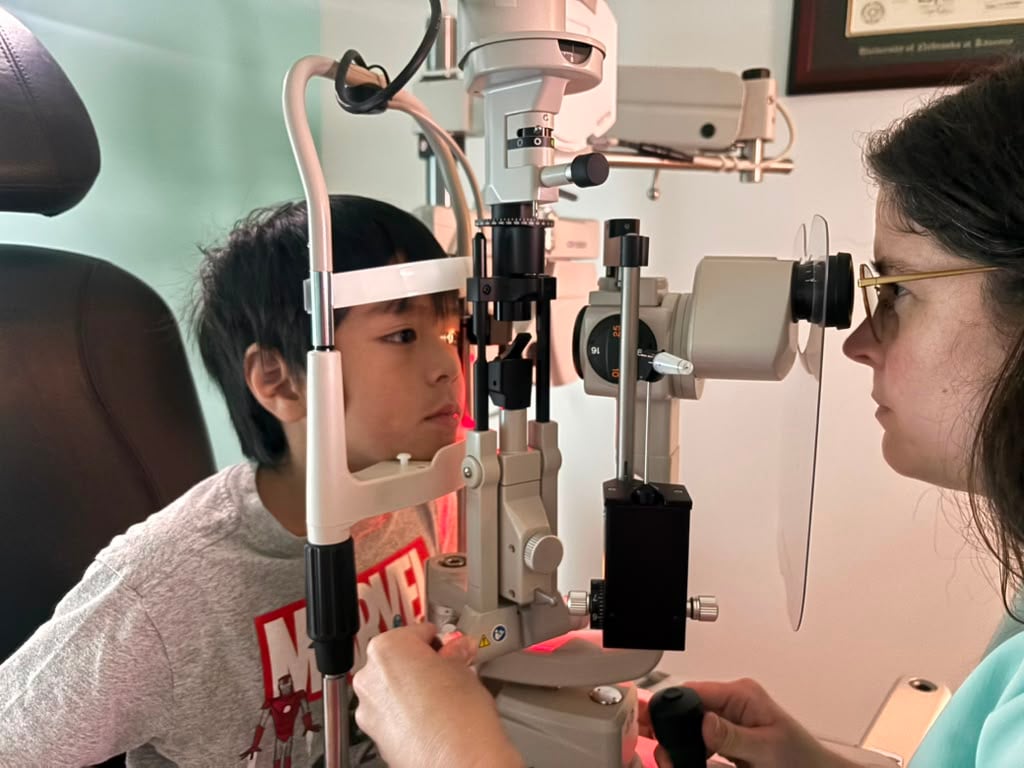
Next, Dr. Teten looks at the front and back of your eyes with a microscope and a bright light. She screens for conditions like glaucoma, macular degeneration and diabetic retinopathy. Many of these have no symptoms early on, which is why a regular exam is worth it even when you feel like you see fine.
Optomap imaging
Navigation Eye Care uses Optomap to take a wide, detailed picture of your retina in seconds. In many cases this lets Dr. Teten see the back of the eye without dilating drops. She’ll show you the image and walk you through what she sees.
What happens during an eye exam for kids
Children’s exams cover the same ground, but Dr. Teten adjusts how she tests. For babies and toddlers, she uses lights, pictures and toys and watches how their eyes respond. Kids don’t need to know their letters or sit perfectly still.
Navigation Eye Care sees children from 6 months old. If you have babies and toddlers at home, an early exam can catch problems before they affect learning.
After your exam
Dr. Teten explains what she found and answers your questions. Depending on the results, next steps may include:
- A prescription for glasses or contact lenses
- A treatment plan for an eye health condition
- A vision therapy evaluation
- Myopia management if your child’s nearsightedness is getting worse
- A date for your next visit
You can try on frames virtually before your appointment, and your picks will be ready when you arrive. You can also order glasses or contacts online with your prescription.
Book an eye exam in Chesapeake
Dr. Teten sees children and families from 6 months old and up, and Dr. Moss cares for adults and patients with medical eye concerns. Call or text 757-529-6889 to book an eye exam.