

I Think My Child Has a Crossed Eye. What Do I Do?
First, don’t wait on this one.
Strabismus is one of those conditions where the window for the most effective treatment is genuinely time-limited. The earlier it’s identified and addressed, the better the outcome. That’s not a scare tactic. It’s just how the developing visual system works.
If you’ve noticed one of your child’s eyes drifting inward, turning outward, or pointing in a different direction than the other especially if it’s consistent, or happening more often than before, a comprehensive eye exam should be your next move, not your last resort.
What Strabismus Actually Is
Strabismus is a misalignment of the eyes. Instead of both eyes pointing at the same target simultaneously, one eye deviates inward (esotropia), outward (exotropia), upward (hypertropia), or downward (hypotropia). It can be constant or intermittent, affecting one eye or alternating between both.
It’s not a muscle weakness in the casual sense. The eye muscles themselves are often structurally normal, the problem is usually in how the brain is coordinating them. That distinction matters because it shapes how we treat it.
Strabismus affects roughly 4% of children. It is not something most kids outgrow on their own, and “they’ll grow out of it” is advice that costs families months of treatable time.
Strabismus vs. Amblyopia — These Are Not the Same Thing
This is where a lot of parent research gets muddled, so let’s be clear.
Strabismus is the eye turn itself, the visible misalignment.
Amblyopia (commonly called lazy eye) is what can develop because of strabismus. When one eye is consistently turned, the brain receives two conflicting images and solves the problem by suppressing the input from the misaligned eye. Over time, the visual pathways for that eye weaken from disuse. That’s amblyopia. Reduced vision in an eye that is structurally healthy, caused by the brain learning to ignore it.
You can have strabismus without amblyopia. But if strabismus goes untreated long enough during the critical window of visual development roughly birth through age 8 to 10 and amblyopia becomes increasingly likely and increasingly difficult to reverse.
Treating the strabismus early protects against that outcome.
Signs to Watch for in Your Child
Strabismus is often visible, but not always. Some forms are subtle or intermittent, appearing only when your child is tired, sick, or focusing at a distance. Here’s what parents at Navigation Eye Care most commonly report noticing first:
One eye that visibly turns in, out, up, or down. This is the clearest sign. It may be constant or only occasional.
Squinting or closing one eye, especially in bright light. This is a coping behavior. Closing one eye eliminates the double image the brain is struggling to reconcile.
Head tilting or turning. Children unconsciously position their head to use their eyes in a way that reduces visual confusion. If your child consistently tilts their head in photos or during conversation, it’s worth investigating.
Complaints of double vision. Older children who can articulate this will sometimes report it. Younger children usually can’t, they just adapt and avoid.
Clumsiness or poor depth perception. Two eyes working together as a team is what creates depth perception. A child whose eyes aren’t coordinating well may misjudge distances, stumble more than expected, or struggle with catching.
What Causes It
Strabismus can be caused by several factors such as refractive errors (particularly significant farsightedness), neurological differences, family history, or conditions affecting the nerves controlling eye movement. In some cases there’s no identifiable single cause. Premature birth and certain developmental conditions also increase risk.
One important point: strabismus can develop even in children who passed an infant vision screening. Screenings check a limited range of visual function. They are not comprehensive eye exams.
How We Diagnose It at Navigation Eye Care
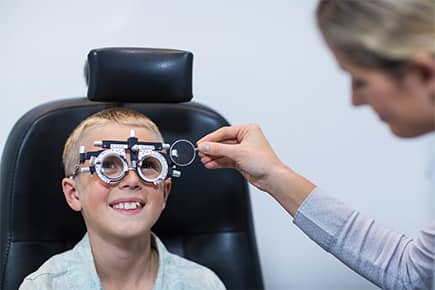
At NEC, a comprehensive pediatric eye exam for suspected strabismus includes assessment of eye alignment at multiple distances, measurement of how each eye focuses independently, evaluation of how well the eyes work as a team, and a full assessment of the health of the eye itself.
For young children who can’t answer “which is clearer,” we use objective measurement techniques that don’t depend on verbal responses. Age is not a barrier to diagnosis.
If strabismus is confirmed, we discuss what type it is, how significant the deviation is, whether amblyopia is already present, and what the treatment pathway looks like all at the same appointment.
Treatment Options — And What They Actually Mean
This is the part parents most want to understand, and it deserves a direct answer rather than a vague list.
Corrective lenses. In cases where strabismus is driven by a significant refractive error, particularly farsightedness, glasses alone can sometimes reduce or eliminate the eye turn by removing the strain that’s causing it. This is called accommodative esotropia, and it’s one of the more straightforward forms to treat when caught early.
Patching or atropine therapy. If amblyopia is already present alongside the strabismus, we need to address both. Patching the stronger eye or using atropine drops to temporarily blur it, forces the brain to use the weaker eye and rebuild those visual pathways. This is done in combination with, not instead of, treating the alignment itself.
Vision therapy. For many children with strabismus, vision therapy is a central part of treatment. This is not eye exercises in the casual sense, it’s a structured, progressive program that retrains the brain to use both eyes together as a coordinated team. At Navigation Eye Care, our vision therapy program is individualized to each child’s specific misalignment pattern, age, and visual development stage. It addresses the neurological coordination problem, not just the surface symptom.
Surgery. In some cases, typically where the deviation is large, constant, or hasn’t responded adequately to non-surgical treatment, strabismus surgery is recommended. Surgery adjusts the tension of the eye muscles to improve alignment. It is performed by an ophthalmologist, and we work collaboratively with surgical colleagues when that referral is appropriate. Surgery and vision therapy are not mutually exclusive and many children benefit from both in sequence.
The right path depends on the type of strabismus, the child’s age, whether amblyopia is present, and how the child responds to initial treatment. There is no universal protocol, which is why the exam matters.
The Window That Parents Need to Understand
The visual system develops rapidly in the first decade of life. The brain is actively building and refining the neural pathways responsible for vision during this period. Interventions during this window such as patching, lenses, vision therapy can produce outcomes that simply aren’t achievable once the system matures.
This doesn’t mean treatment is useless after age 10. It means the degree of improvement possible is greater the earlier you start. A child identified and treated at age 3 has a significantly different prognosis than one identified at age 7, who still has a meaningfully better prognosis than one identified at 12.
If you’ve been told to “wait and see” without a clear clinical reason, it’s worth getting a second opinion.
Serving Chesapeake Families Across Great Bridge, Hickory, Greenbrier, and Deep Creek
Dr. Amber Teten and the team at Navigation Eye Care specialize in pediatric and specialty eye care. Strabismus evaluation, amblyopia management, and vision therapy are core parts of what we do every day, not occasional referrals.
If you’ve noticed something off with your child’s eyes, or if a pediatrician, teacher, or school screening has flagged a concern, the right next step is a comprehensive exam. One appointment gives you a clear picture and a real plan.
Noticed an eye turn? Don’t wait for the next well-child visit. Book Online or call (757) 529-6889.